

Precise spreading
Accurate nutrient application starts with high-quality fertilizer granules. Consistent density, granule size, hardness, shape, and resistance to caking ensure reliable spreading performance, smooth product flow, and uniform nutrient distribution across the field.
Uneven spreading can create visible light and dark stripes in crops, leading to inefficient nutrient use, yield losses, and reduced crop quality. High-quality fertilizers help achieve precise application, even at wide working widths.
HIGH DENSITY
Granular fertilizers from LAT Nitrogen have a density above 0.9 t/m³
OPTIMISED GRANULE SIZE
90% of granules measure 2 to 5 mm
RESISTANCE TO CLUMPING
GRANULE HARDNESS
Benefits
Accurate and uniform nutrient distribution
Reliable spreading performance, even under challenging conditions
Reduced dust and improved product flow
Better nutrient use efficiency
Improved crop uniformity, yield, and quality
Consistent physical quality across all LAT Nitrogen products
The quality of fertilizer distribution is measured by the Coefficient of Variation (CV). The lower the CV, the more uniform the nutrient distribution.
CV 0-10%: Good
CV 10-15%: Moderate
CV >15%: Poor
Nitrogen distribution
Precise nitrogen application is essential for maximizing both yield and crop quality. Poor fertilizer distribution can result in visible stripes or waves across the field, causing areas of significant over- or under-application.
Uneven nitrogen distribution leads to differences in crop development, reduced yield potential, and lower protein content. At the same time, applying nitrogen above the economic optimum increases costs, reduces profitability, and raises the risk of nutrient losses to the environment.
Accurate spreading ensures that nutrients are delivered where they are needed, supporting uniform crop growth, efficient nitrogen use, and optimum economic returns.
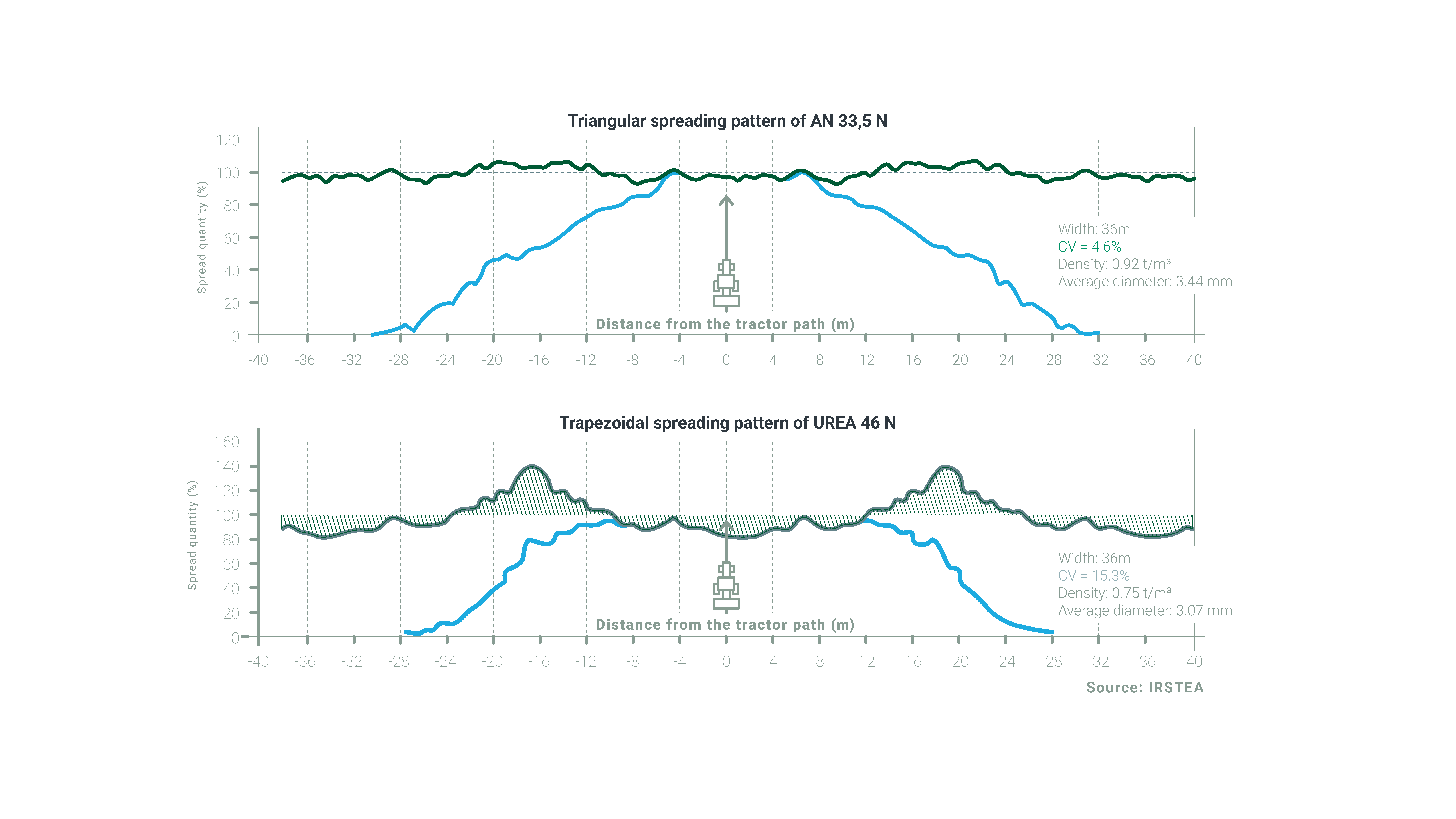
Uneven Nitrogen Distribution
A common misconception is that uneven fertilizer application will balance out across the field. In reality, areas receiving excess nitrogen cannot compensate for the yield losses in under-fertilized areas.
This is because crop response to nitrogen follows a diminishing returns curve: once the optimum nitrogen rate is reached, additional fertilizer delivers only limited yield benefits. In contrast, areas receiving too little nitrogen can suffer significant reductions in yield and crop quality.
As a result, uneven nitrogen distribution lowers overall field performance, reduces nitrogen use efficiency, and can negatively affect both yield and protein content, even in the absence of visible crop damage.
Illustration of yield and revenue effects resulting from nitrogen application rates below and above the economic optimum (200 kg N/ha). Because the nitrogen response curve flattens near the optimum, the losses caused by under-fertilization (red) are greater than the gains achieved through over-fertilization (green).